

Facebook & Instagram Ads · Q4 2026
If you run Facebook or Instagram ads for your business, you may have noticed they don’t stretch quite as far as they used to. Meta’s latest results put some numbers behind that feeling.
The good news is that a rising price per ad doesn’t have to mean fewer good enquiries. It does mean every dollar needs to work harder. Below we look at what Meta reported, what it does and doesn’t tell you, and four practical ways to keep the leads coming this Q4.
What Meta reported for Q3 2026
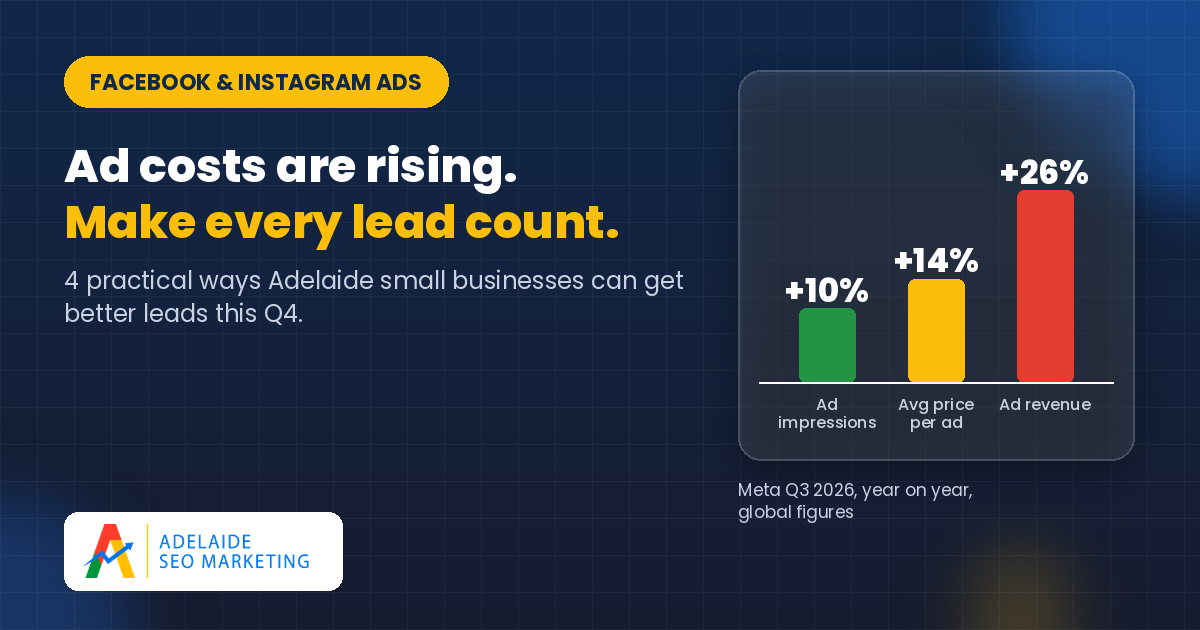
On 21 October 2026, Meta Platforms released its results for the quarter ended 30 September 2026. Compared with the same quarter in 2025, Meta reported that:
- average price per ad increased by 14%
- ad impressions delivered across its Family of Apps increased by 10%
- advertising revenue was US$63.06 billion, up 26%.
In plain terms, Meta showed more ads than a year earlier, and on average it charged more for each one.
What these numbers mean for you (and what they don’t)
These are global figures for Meta’s whole business. They are not Australian figures, and they are not specific to any industry or to small businesses. An average across the world tells you the direction of the market, not what your own campaigns will cost. Your results will depend on your audience, your offer, your creative, your competition and how your account is set up.
What the numbers do suggest is that it’s a good time to tighten things up rather than simply increase your budget and hope for the best. Q4 is also when many businesses push their Christmas and end-of-year offers, so it pays to be prepared.
1. Tighten your targeting around real customers
Start with who actually buys from you. Think about the suburbs you service, the type of customer who becomes a good client, and the people who are unlikely to ever convert.
- Check your location settings. Make sure your ads are shown where you can genuinely deliver, rather than a broad radius that includes areas you don’t service.
- Use what you already know. Your existing customers and website visitors are often your best starting point for audiences, as long as you have the right permissions to use that information.
- Exclude people who aren’t a fit. For example, existing customers for a new-customer offer, or recent enquirers who are already in your sales process.
- Don’t over-narrow. Meta’s delivery system needs room to find people. Very small audiences can limit results, so test and adjust rather than stacking every filter at once.
2. Keep your creative fresh
When the same ad runs for weeks, people see it again and again and stop noticing it. Fresh creative gives you a better chance of earning attention.
- Plan a few variations. Different images, short videos and headlines for the same offer let you see what works.
- Lead with the customer’s problem. Your ad has a second or two to show someone it’s relevant. Say who it’s for and what they get.
- Show your real business. Photos of your team, your premises and your work are often more convincing than generic stock images.
- Refresh on a schedule. Check performance regularly and swap out ads that are slowing down, rather than waiting for results to drop away.
3. Send clicks to a landing page that converts
If you’re paying more to get someone to click, make sure the page they land on gives them every reason to enquire.
- Match the page to the ad. If the ad promises a specific offer, the page should show that same offer straight away.
- Make it fast and mobile friendly. Most people will see your ad on their phone, so test the page on yours.
- Keep the form short. Ask only for what you need to follow up.
- Build trust. Reviews, photos of your work, your location and clear contact details help people feel comfortable getting in touch.
- Consider instant forms. Meta’s lead ads with instant forms let people enquire without leaving Facebook or Instagram. They can be convenient, but it’s worth adding a question or two to help filter out low-quality enquiries.
4. Track lead quality, not just clicks
Clicks and cheap leads look good in a report, but they don’t pay the bills. What matters is how many enquiries turn into real customers.
- Record where each lead came from. Even a simple spreadsheet noting the source, the date and the outcome is a big step up from guessing.
- Follow up quickly and record the result. Note whether each lead was qualified, quoted or won.
- Judge campaigns on cost per good lead. A campaign with fewer but better enquiries can be worth more than one with lots of low-quality leads.
- Feed results back to Meta. Meta’s Help Center explains that its qualified leads performance goal works by connecting your customer relationship management (CRM) system, so Meta can learn which leads progress. Since April 2026, Meta says new campaigns need a Conversions API integration to use that goal. If you use a CRM, it’s worth asking whether this is set up.
A quick Q4 checklist
- Review your location and audience settings
- Prepare at least two or three fresh ad variations
- Check your landing page on a phone, including the form
- Set up a simple way to track lead source and outcome
- Decide what a “good lead” means for your business and measure that
How we can help
If you’re not sure whether your ad spend is working as hard as it could, Adelaide SEO Marketing offers a free Facebook and Instagram ad account review. We’ll look at your targeting, creative, landing pages and tracking, and give you practical suggestions in plain English.
Get in touch with our Adelaide team to book your free review.
Sources
- Meta Platforms, “Meta Reports Third Quarter 2026 Results” (21 October 2026): https://investor.atmeta.com/investor-news/press-release-details/2026/Meta-Reports-Third-Quarter-2026-Results/default.aspx
- Meta Business Help Center, “About performance goals for lead ads”: https://www.facebook.com/business/help/782657799338685
- Meta Business Help Center, “Set up your CRM for qualified leads”: https://www.facebook.com/business/help/279369167153556
SEO That Converts: More Clicks, More Customers.
Your journey to online success begins here, with Adelaide SEO Marketing. We’re not just a service; we’re your partners in growth.
