

Content · AI Writing
You’ve probably tried it. Open an AI tool, type “write a blog about bathroom renovations in Adelaide”, and a few seconds later you have 1,000 tidy words. Publish, repeat, wait for the enquiries.
And then… nothing much happens.
It’s not because Google hates AI. It’s because generic content, however it’s made, gives Google very little reason to show it. Here’s what Google actually says, and how to turn AI from a shortcut into a genuinely useful tool.
Does Google penalise AI content?
No, not simply for being AI. Google’s guidance says its ranking systems aim to reward original, high-quality content, and that it focuses on the quality of content rather than how it’s produced.
Google also says, rather bluntly: using AI doesn’t give content any special gains. It’s just content. If it’s useful, helpful and original, it might do well. If it isn’t, it might not.
Where Google draws the line is intent and value. Its spam policies describe scaled content abuse, which includes using generative AI tools to create many pages without adding value for users. Pumping out dozens of near-identical posts to chase keywords falls squarely into that.
Why generic AI posts struggle
They say what everyone else says
AI tools predict likely words based on what they’ve been trained on. Ask for a post on “SEO tips” and you’ll get the most average version of every SEO tips post ever written.
Google’s helpful content guidance asks questions like:
- Does the content provide original information, reporting, research or analysis?
- Does it provide insightful analysis or interesting information that is beyond the obvious?
- Does it provide substantial value compared to other pages in search results?
A generic AI post usually fails all three.
They have no first-hand experience
One of Google’s people-first questions is whether your content clearly demonstrates first-hand expertise and a depth of knowledge, for example from actually using a product or service or visiting a place.
An AI tool has never fixed a leaking shower in a 1960s Elizabeth home or helped a Hahndorf cafe through a busy long weekend. You have.
They can be confidently wrong
Google’s own guidance on generative AI warns that these models don’t retrieve facts, they predict a likely sequence of words, so outputs may contain inaccuracies. Google says it’s critical to manually fact-check and review all AI-generated content before publishing, including titles, meta descriptions and image alt text.
One wrong price, regulation or claim can cost you trust with a customer, and that’s worse than not posting at all.
They’re written for word count, not readers
Many people still believe Google prefers a certain length. Google’s helpful content page addresses this directly: it asks if you’re writing to a particular word count because you’ve heard Google has a preferred word count, and answers, “No, we don’t.”
What Google rewards instead
Google sums it up in its guidance on succeeding in AI search: focus on making unique, non-commodity content that visitors will find helpful and satisfying. That’s good advice for every blog you publish.
Add what only your business knows
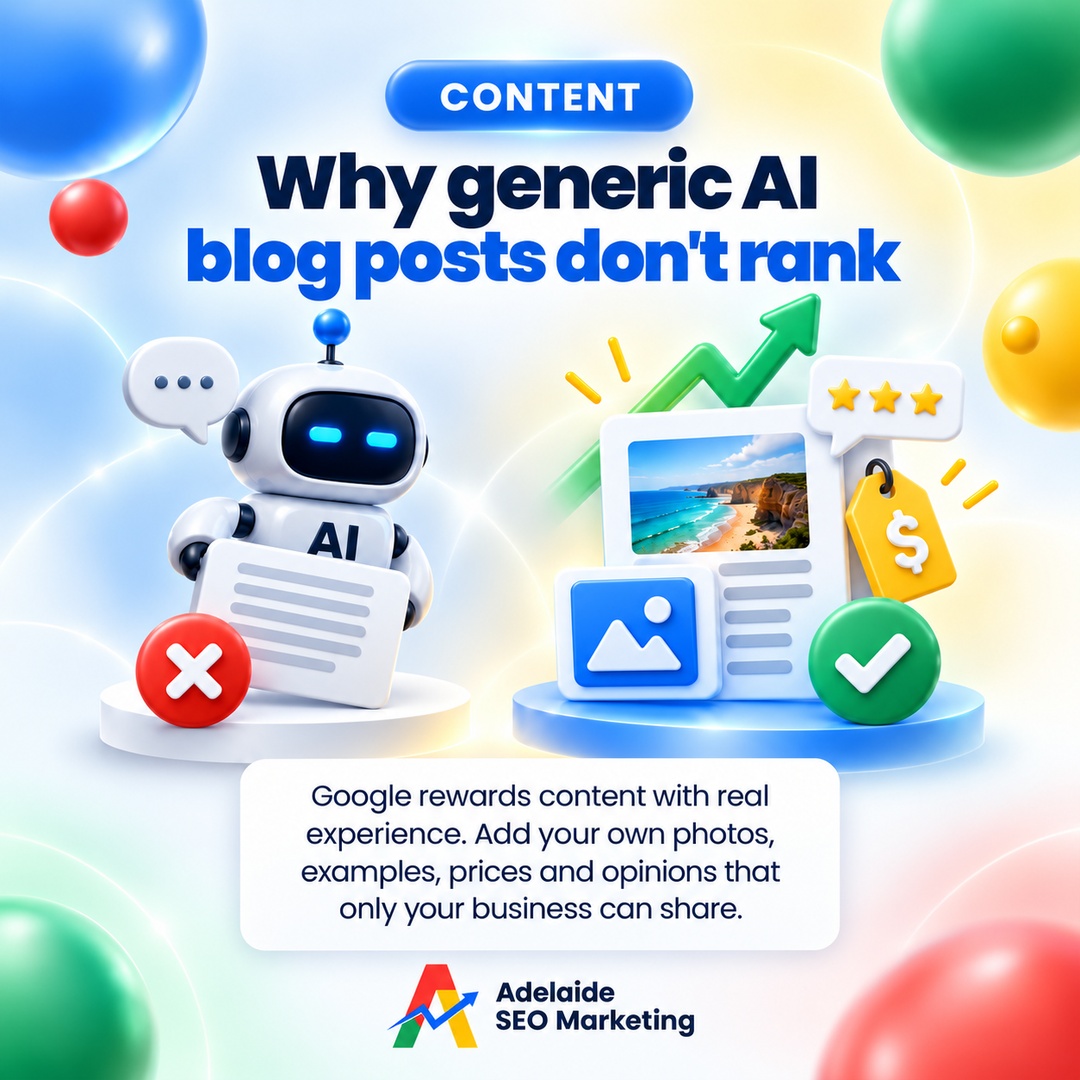
The story we shared this week put it simply: add your own photos, examples, prices and opinions that only your business can share. In practice that might mean:
- Your photos: real before and after shots, your team on site, your products on your shelves
- Your examples: “Last month we helped a family in Modbury who…” (with permission and without private details)
- Your prices or price ranges: even a rough guide is more useful than “costs vary”
- Your opinions: when you’d recommend one option over another, and why
- Your local knowledge: council rules, suppliers, seasonal timing in South Australia
Make it clear who wrote it
Google encourages thinking about “Who, How and Why”. Readers should be able to tell who created the content, ideally with a byline and a link to an author or About page. Google suggests adding bylines where readers would reasonably ask, “Who wrote this?”
Be honest about how it was made
If AI played a big part, Google suggests that disclosures can be useful where someone might reasonably wonder how the content was created. Google also notes that listing AI as the author probably isn’t the best approach.
How to use AI the right way
AI can absolutely help. Google itself says generative AI can be useful for researching a topic and adding structure to original content. A sensible workflow looks like this:
- Start with your knowledge. Jot down the questions customers ask, your process, your prices and a recent job.
- Use AI to organise. Ask it to suggest headings or tidy up your notes, not to invent the content.
- Add your proof. Photos, examples, numbers you can stand behind.
- Fact-check everything. Every claim, every figure, every regulation.
- Edit for your voice. It should sound like you talking to a customer at the counter.
- Publish less, but better. One genuinely helpful post a month beats twenty forgettable ones.
A quick test before you hit publish
Ask yourself: if a customer read this post, would they learn something they couldn’t get from the first five results on Google? Would they come away thinking, “These people clearly know what they’re doing”? If not, keep editing.
AI content FAQs
Is it against Google’s rules to use ChatGPT for blog posts?
No. Google says appropriate use of AI isn’t against its guidelines. The problem is using it mainly to manipulate rankings or to churn out pages without adding value.
How long should my blog posts be?
As long as it takes to fully answer the question well. Google states it doesn’t have a preferred word count.
Should I delete my old AI-written posts?
Not automatically. Review them first. Improve the ones that cover useful topics by adding real examples and checking facts, and consider combining or removing ones that add nothing new.
Keep reading
Sources
- Google Search Central Blog, Google Search’s guidance about AI-generated content
- Google Search Central, Google Search’s guidance on using generative AI content on your website
- Google Search Central, Creating helpful, reliable, people-first content
- Google Search Central, Spam policies for Google web search (scaled content abuse)
- Google Search Central Blog, Top ways to ensure your content performs well in Google’s AI experiences on Search
Want content that actually works?
Our team can review your existing blog posts, show you which ones are pulling their weight, and help you build content that reflects your real expertise. Book a free SEO audit or get in touch.




SEO That Converts: More Clicks, More Customers.
Your journey to online success begins here, with Adelaide SEO Marketing. We’re not just a service; we’re your partners in growth.
