

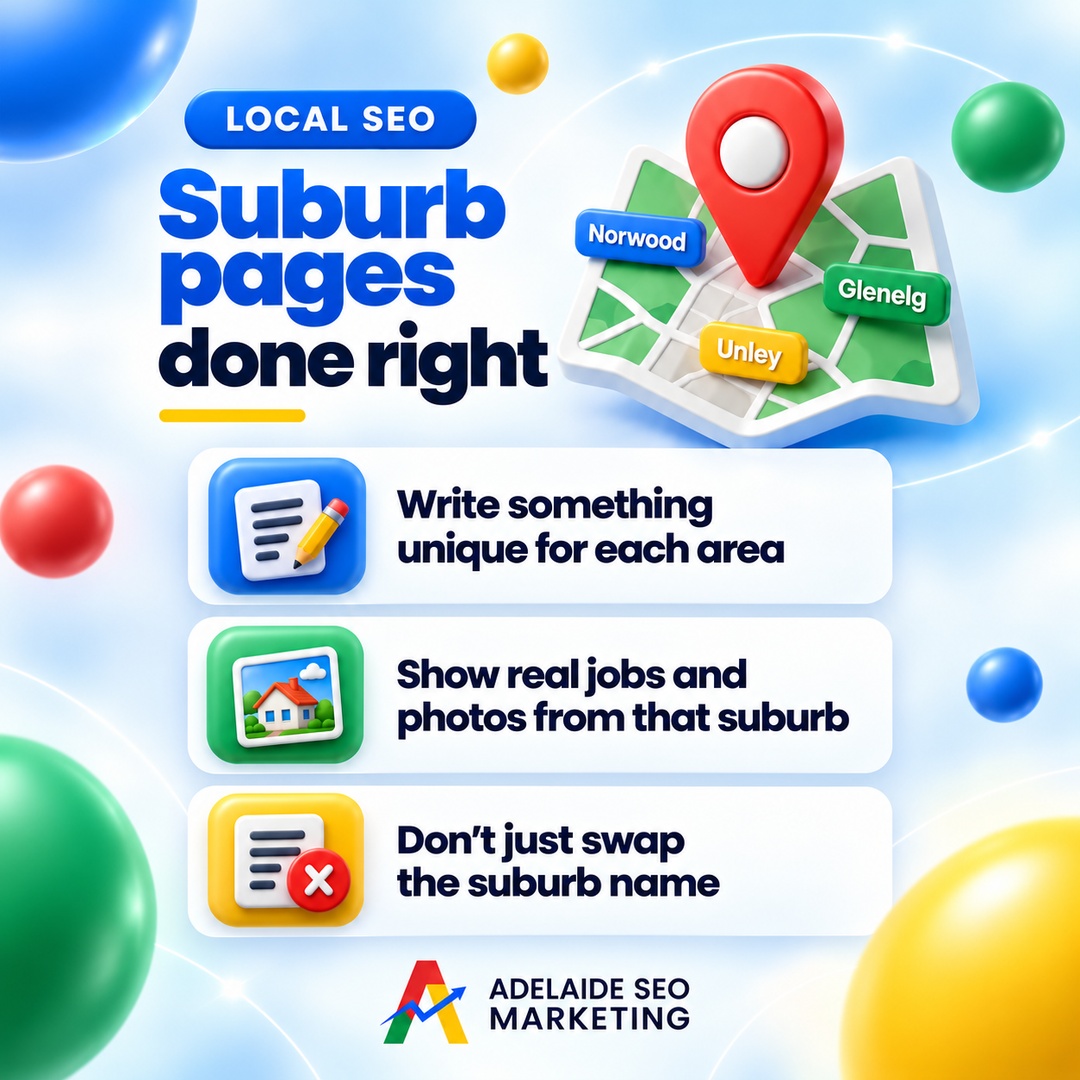
Local SEO · Suburb Pages
If you serve customers right across Adelaide, it’s tempting to create a page for every suburb you work in. “Plumber Glenelg”, “Plumber Norwood”, “Plumber Salisbury”, and so on, with the same text and only the suburb name changed.
It feels efficient. Unfortunately, it’s also exactly the kind of thing Google’s spam policies describe. The good news is that suburb pages can work really well when they’re built for people first. Here’s how to tell the difference.
Why businesses build suburb pages
People often search with a place in mind: “electrician Prospect”, “dog groomer Blackwood”, “accountant near Unley”. A page that genuinely covers your work in that area can be a helpful answer to that search.
The problem isn’t suburb pages. The problem is thin, copy-paste suburb pages.
What Google says about location pages
Google’s spam policies include something called doorway abuse. Google describes it as pages created to rank for specific, similar search queries that lead people to intermediate pages that aren’t as useful as the final destination.
Two of Google’s listed examples are worth reading slowly:
- Having multiple domain names or pages targeted at specific regions or cities that funnel users to one page
- Creating substantially similar pages that are closer to search results than a clearly defined, browseable hierarchy
Google also has a policy on scaled content abuse: creating many pages mainly to manipulate rankings, with little value for users, however the pages are produced. That includes using AI tools to generate many pages without adding value.
So the test is simple. If you deleted the suburb name, would the page be identical to twenty others on your site? If yes, it’s probably not helping anyone.
The three rules for suburb pages that actually help
Rule 1: Write something unique for each area
Every suburb page should say something that’s only true for that area. Ask yourself:
- What kind of jobs do we do most often here?
- Are there local quirks? Older homes in Norwood and Kensington, newer estates in Mount Barker, salty coastal air in Semaphore, sloping blocks in the Adelaide Hills.
- How quickly can we usually get there? Do we have a team based nearby?
- Are there council requirements or local conditions customers should know about?
If you can’t think of anything genuinely different to say about a suburb, that’s a sign it might be better covered on a broader regional page instead.
Rule 2: Show real jobs and photos from that suburb
Google’s helpful content guidance asks whether your content shows first-hand experience, for example from actually visiting a place or doing the work. Nothing demonstrates that better than proof.
- Photos of real jobs completed in that area (with the customer’s permission)
- A short write-up of a recent project: the problem, what you did, the result
- Reviews from customers in that suburb, if they’re happy for you to share them
This is the content no competitor can copy, and it’s the content that reassures someone they’re calling the right business.
Rule 3: Don’t just swap the suburb name
Find-and-replace pages are the clearest sign of a doorway. Avoid:
- The same paragraphs with only the suburb changed
- Long lists of suburbs or postcodes stuffed into the footer or body text
- Pages that exist only to push visitors straight to your contact form
Instead, give each page a clear purpose and useful detail, then link naturally to your main service pages.
Structure your site so it makes sense
Google prefers a clearly defined, browseable site structure over a pile of near-identical pages. For most Adelaide service businesses, that looks something like this:
- Main service pages (for example, Hot Water Repairs, Blocked Drains)
- Regional or area pages that genuinely differ (for example, Northern Suburbs, Southern Suburbs, Adelaide Hills)
- Suburb pages only where you have real substance, such as a team based there, lots of local jobs or local conditions worth explaining
Google’s SEO Starter Guide also suggests organising similar topics into directories and using descriptive URLs, so a structure like /services/blocked-drains/ and /areas/adelaide-hills/ is easy for both people and Google to follow.
What about duplicate content?
Google says duplicate content isn’t a spam violation on its own, but it can be a bad user experience and waste crawling on URLs you don’t care about. Doorway-style pages are a different matter, because they’re built to manipulate rankings.
Don’t forget your Google Business Profile
Suburb pages and your Business Profile should tell the same story. Google’s guidelines say:
- Service-area businesses (those that travel to customers) should have one profile for their base with a defined service area, and should hide their address if customers don’t visit
- Your service area shouldn’t generally extend further than about two hours’ drive from where you’re based
- You can’t create profiles for virtual offices or locations where you don’t actually operate
So if you’re a Lonsdale-based tradie covering the south, make sure your service area is set correctly, and let your website’s area pages add the detail.
A quick self-check for your existing suburb pages
- Read three of your suburb pages side by side. Are they mostly the same?
- Does each page include at least one real local job, photo or customer story?
- Would a customer in that suburb learn something useful they couldn’t get from your main service page?
- Are you only targeting areas you genuinely service?
If you answered “no” to a few of these, it’s worth combining or rewriting pages before adding more.
Suburb page FAQs
How many suburb pages should I have?
There’s no magic number. Create a page only where you have something genuinely useful and specific to say. A few strong area pages are better than dozens of thin ones.
Can I use AI to write my suburb pages?
AI can help with structure and drafting, but Google’s guidance warns against generating many pages without adding value. Add real local detail, photos and job examples, and fact-check everything before publishing.
Should I add a fake address in each suburb to my Business Profile?
No. Google’s guidelines require a real, staffed location or a properly set service area. Virtual offices and locations where you don’t operate aren’t eligible.
Keep reading
Sources
- Google Search Central, Spam policies for Google web search (doorway abuse, scaled content abuse)
- Google Search Central, Creating helpful, reliable, people-first content
- Google Search Central, Google Search’s guidance on using generative AI content
- Google Search Central, SEO Starter Guide (descriptive URLs, site organisation, duplicate content)
- Google Business Profile Help, Guidelines for representing your business on Google
Need help with your local pages?
We can review your service and suburb pages and show you which ones are helping, which ones need work and which ones could be combined. Get your free SEO audit or contact our Adelaide team.


SEO That Converts: More Clicks, More Customers.
Your journey to online success begins here, with Adelaide SEO Marketing. We’re not just a service; we’re your partners in growth.
