

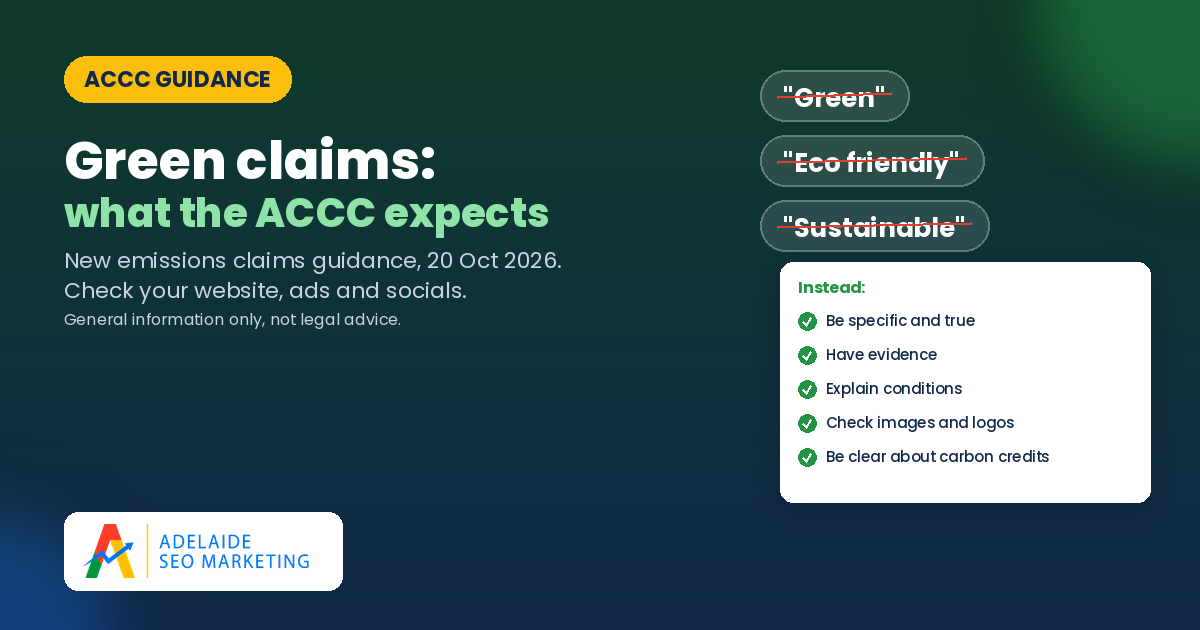
ACCC Guidance · Green Claims
More customers care about the environmental impact of what they buy, so it’s natural to want to tell them about the good things your business is doing. The catch is that environmental claims are an area the Australian Competition and Consumer Commission (ACCC) is watching closely.
On 20 October 2026, the ACCC released new guidance on emissions claims, adding to its 2023 guidance on environmental claims. This article explains what the ACCC expects, in plain English, and how to check the words and images on your website, ads and social media.
This article is general information only and isn’t legal advice. If you’re unsure about a specific claim, speak with a lawyer or adviser.
Why this matters for small businesses
The ACCC says businesses have responsibilities under the Australian Consumer Law not to make false or misleading claims, and that false or misleading environmental claims risk breaching that law.
The ACCC describes greenwashing as using any claim, or leaving out key information, in a way that makes a product or service seem better or less harmful for the environment than it really is. It also says businesses sometimes mislead consumers accidentally.
The ACCC has said that environmental claims and sustainability, with a focus on greenwashing, is a current compliance and enforcement priority.
What’s new: the October 2026 emissions claims guidance
The ACCC’s new guide is called Making emissions claims to consumers: a guide for business. In its announcement, the ACCC said businesses making greenhouse gas emissions claims should:
- use credible, science-based accounting standards
- be transparent about the use of purchased credits
- above all, consider what average consumers would understand their claims to mean.
The ACCC also urged businesses to:
- base emissions claims on complete, reputable and clear accounting
- avoid highly selective, broad or non-specific claims
- avoid “double counting” changes to emissions
- be clear about what is the business’s own effort, what is a broader change available to everyone, and what is a legal obligation
- only make claims about the future where they have reasonable grounds.
On carbon credits, the ACCC says they can complement direct emissions reductions. But if your marketing gives the impression that buying credits and your emissions are equivalent, or cancel each other out, you must have a reasonable basis for that claim. The ACCC wants consumers to be able to tell the difference between emissions you’ve actually reduced and credits bought from projects elsewhere.
The ACCC also noted that some large companies have moved away from vague, widely advertised “carbon neutral” claims and distant future targets, towards being more open about their real-world impact and their reliance on credits.
The eight principles for any environmental claim
The ACCC’s 2023 guidance sets out eight principles that apply to all environmental claims, not just emissions:
- Make accurate and truthful claims
- Have evidence to back up your claims
- Don’t hide or omit important information
- Explain any conditions or qualifications on your claims
- Avoid broad and unqualified claims
- Use clear and easy-to-understand language
- Visual elements should not give the wrong impression
- Be direct and open about your sustainability transition
Words the ACCC recommends avoiding
The ACCC specifically names some broad terms it recommends businesses avoid, because they can be read in many ways:
- “Green”: vague, and conveys little information beyond a general suggestion of being less damaging.
- “Environmentally friendly” or “eco friendly”: risks suggesting no harm at all, when the ACCC says few, if any, products can truthfully claim that.
- “Sustainable”: overly general, and risks suggesting resources are used at a rate that causes no environmental harm.
Instead, the ACCC’s guidance points towards specific, qualified claims backed by evidence. Its own example is a product described as “does not harm the environment” when only the bottle is recycled. The ACCC suggests saying what is actually true, such as which parts are made from recycled material.
It’s not just the words
The ACCC says a business needs to consider the overall impression a claim creates, including what’s left out and the visual elements, colours and logos used. Green colours, leaf imagery or recycling symbols can all shape what a customer believes.
The ACCC gives the example of the recycling symbol (the mobius loop): without further explanation, it may suggest a whole product and its packaging are recycled or recyclable when that isn’t the case.
Small print matters too. The ACCC says small print shouldn’t hide the truth or conflict with the overall message of the claim.
Where to check your claims
Environmental wording often turns up in more places than people expect. Check:
- Your website: home page, about page, product and service pages, and footer badges.
- Ads: Google, Facebook and Instagram ad copy, images and video.
- Social media: bios, pinned posts and older posts that are still visible.
- Google Business Profile: your description, attributes and posts.
- Packaging, quotes and email signatures.
A simple checklist
For each environmental claim you find, ask:
- Is it true and specific? Could you replace a broad word like “eco” with a precise fact?
- Can you prove it? Do you have evidence, and could a customer find it easily?
- Is anything important missing? Would the full picture change how a customer sees the claim?
- Are there conditions? For example, is something only recyclable through a special collection?
- Do the images match? Do colours, icons or symbols suggest more than the words do?
- Is it about the future? If you mention a target, do you have a genuine plan and reasonable grounds?
- Do you mention carbon credits? Be clear about what you’ve actually reduced and what relies on credits.
The ACCC’s advice for existing claims is straightforward: if a claim raises concerns, update the messaging, gather stronger evidence, or reconsider using it.
How we can help
Many environmental claims sit in website copy, ads and social posts that were written years ago. If you’d like help finding and tidying up that wording, Adelaide SEO Marketing can review your website, ad and social media copy and flag claims that may need a closer look, so you can take the right questions to your adviser.
Get in touch with our Adelaide team to arrange a review.
This article is general information only and isn’t legal advice.
Sources
- ACCC, “ACCC releases guidance on business emissions claims to consumers” (20 October 2026): https://www.accc.gov.au/media-release/accc-releases-guidance-on-business-emissions-claims-to-consumers
- ACCC, “Environmental and sustainability claims”: https://www.accc.gov.au/business/advertising-and-promotions/environmental-and-sustainability-claims
- ACCC, “ACCC releases eight principles to guide businesses’ environmental claims” (12 December 2023): https://www.accc.gov.au/media-release/accc-releases-eight-principles-to-guide-businesses%E2%80%99-environmental-claims
Related Posts

SEO That Converts: More Clicks, More Customers.
Your journey to online success begins here, with Adelaide SEO Marketing. We’re not just a service; we’re your partners in growth.
